

White Label Local SEO: How It Works, What to Ask, and Who Holds the Keys

Updated: 7 days ago
White label local SEO is local search work, on a business's Google Business Profile, its listings on other sites and the location pages on its website, done by one company and sold by another under its own name. The agency sells the package and stays the client's contact. The supplier makes the changes. The reports carry the agency's logo.
It is the same shape as a builder who subcontracts the electrical: the builder is responsible to the customer, the electrician is responsible to the builder, and the job is fine as long as everybody knows who holds the keys when it is done. In local SEO the keys are the Business Profile, often the most valuable thing a local business has in search, and this page is mostly about who ends up holding it.
What does white label local SEO include?
A white label local SEO package usually includes some mix of: setting up and improving the Google Business Profile, keeping the business's name, address and phone number consistent across directory listings, writing Google posts, managing reviews and replies, building local links, and editing location pages on the website. Many packages add a monthly report in the agency's branding.
Item | Lives on | Who should own it |
Google Business Profile | The business, as primary owner | |
Directory listings (name, address, phone) | Third-party sites | The business's own accounts where the site allows it |
Reviews and replies | The profile | The business; replies are written in its voice |
Location and service pages | The business's website | The business, with the site's owner role |
Local links | Other websites | n/a: they point at the business's site |
Monthly report | The agency | Shared with the client |
How does white label local SEO work?
The agency sells a local SEO package to its client and keeps the relationship. The white label supplier is given access to the client's profile, listings and site, makes the changes, and writes the reports under the agency's brand. The agency sends the reports and answers the client's questions. The client may never hear the supplier's name.
That is normal. It is an ordinary way to sell a service, and it is not a reason to worry by itself. Where it goes wrong for a local business is not the reselling. It is who ends up holding the profile.

From Capron Media: the free Lite subscription

Where does your business show on the map?
Choose your Google Business Profile and see where your business shows up in local map results. Lite does not include the work on your site. Starter does.
Is white labeling illegal?
No. Reselling a service under your own brand is an ordinary commercial arrangement, the same one behind the store-brand tin on a supermarket shelf. Whether the agreement you signed is sound is a question for a lawyer rather than a blog. What this page can tell you is where the arrangement goes wrong in local search.
Who should own the Google Business Profile?
The business should. Google lets a profile have several owners but only one primary owner, and a manager role that can edit the profile, reply to reviews and post updates, but cannot add or remove users or delete the profile. A supplier or agency needs the manager role to do the work. Primary ownership should stay with the business.
The owner role
If the supplier or the agency was made the primary owner instead, or the profile was verified under their Google account rather than yours, then the asset your calls come from is registered to somebody else. Ask who verified the profile and under which account, and if the answer is not the business, ask for primary ownership to be transferred. A good agency does this without fuss.
The details customers use
Hours, phone number, address, service area, and the categories the profile is listed under. Anyone with access can change these, and a wrong phone number on a profile costs calls from the moment it goes live. Ask for the list of profile changes made last month, with dates. A good supplier keeps that list for themselves anyway.
The reviews and the replies
If somebody replies to reviews on the business's behalf, they are speaking as the business to people deciding whether to call. Ask who writes those replies and whether the business sees them first. A reply written by someone who has never met the customers can read that way.
The pages on the website
Location pages and service pages are the website half of local. Ask who edits them and under which login. Who should hold the site's logins, what the agreement should say about the words on the pages, and what the fee pays for when two companies are on the account are covered in our separate post on reselling SEO under your agency's name.


The five-minute check a business owner can run
Open your Google Business Profile and find the list of people with access to it. Read who is listed as the primary owner, and whether that is your own Google account or somebody else's. Then open your website's user or team list and read who holds the owner or admin role there. It should be you, in both places.
If it is, you are fine, and the rest of this page is about what to ask at the next renewal. If it is not, that is the first conversation to have, and it is not an accusation. Access set up in the wrong name is a shortcut somebody took on day one, not a plan.

What should an agency ask a white label local SEO supplier?
Four questions settle most of it. Under whose account will the client's profile be verified, and who will be primary owner. Which profile fields will you change in the first month, and will you list them with dates. Who writes review replies, and does the client see them first. And what stays with the client if either of us leaves.
The behaviour to refuse: rip and replace in week one
If a profile is already bringing calls, the first month of any new arrangement should leave it alone. Keep what is working running as it is, read what is there before touching anything, and change one thing at a time so you can tell what moved. A supplier who starts by rewriting the categories, the description and the hours in the first week is more likely running a template than reading the profile, and that is the behaviour to refuse whoever is doing the work.

The questions that surface this before you pay are the same ones in how to choose an SEO agency, and they apply to a reseller, a supplier and a one-person shop alike.
How much does white label local SEO cost?
White label local SEO is usually priced as a monthly fee per location. The supplier charges the agency a wholesale price; the agency adds its own margin for holding the client and the responsibility. Prices vary with how many listings, posts and pages each month includes, so compare packages by that list, not by the headline price.
Should an agency white label local SEO, refer it, or do it in-house?
White label it if local SEO is becoming a real line of your business and you are ready to answer for work you do not do yourself. Refer it if clients ask now and then and you would rather they deal with the provider directly. Do it in-house only if you can staff it every month, because profiles drift.
Option | What it means | Whose name the client sees | Who answers for the profile |
White label local SEO | A supplier does the work; you sell it as yours | Yours | You |
Refer the client | The client buys from the provider directly | The provider's | The provider |
In-house | Your own staff do the work | Yours | You |
Capron Media (ours) | SEO referral program: Referral terms with nothing to sign. No quota. No white label. | Ours | Starter does not include Google Business Profile or local listings work. |
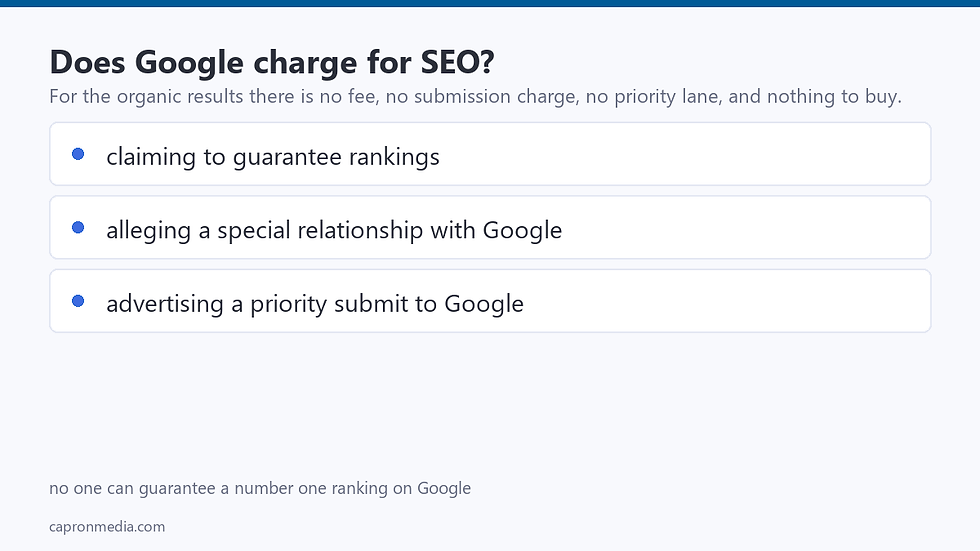
As for which supplier is best: no list can answer that for you, because the best one is the one whose work you can check and whose tactics you would put your own name to. Ask the four questions above, ask each supplier for a sample month with client details removed, and read their own sales copy for promised rankings.
Does Capron Media offer white label local SEO?
No. Capron Media does not do white label work, and we do not work on Google Business Profiles or local listings at all: Starter does not include Google Business Profile or local listings work. We do the website half of local, on a site the business keeps.
If the map is where your clients' customers find them, that part is not ours, and we would rather you knew before you referred anyone than after.
We run a referral program for small agencies, web designers and advisers whose clients ask about SEO. Once terms are agreed, referral partners can run three full audits a month on clients' sites at no charge, carrying the partner's business name beside ours, to share with the client before referring them. The full terms are on our SEO referral program page.
Whoever does the work, local SEO does not end
A profile that was correct in March is wrong by September if the hours changed and nobody updated it, and the pages on the site drift the same way. The continuing half of the job matters more than who did the first month, and it is set out in our guide to ongoing SEO.

We sell the website half of local, for one website, at one flat price, with no contract: a fixed number of things done to the pages every week, on a site the business keeps the keys to. What that costs is on our pricing page. It is one number, and Google Business Profile and local listings are listed there as things we do not do.
And if you would rather talk through who holds what before you decide anything, book a free SEO consultation.
From Capron Media: the free Lite subscription

See what to fix first on any website
Your own site doesn't use up a check. You can check up to three other sites, each once every 30 days. Lite does not include the work on your site. Starter does.
If you would rather have the work done for you, Starter is five optimizations a week, made for you on the site you already own, and each one shown in your portal. See every price.
Written by Spencer Capron, founder of Capron Media, a Middleborough, Massachusetts SEO service for small business owners. Spencer is HubSpot SEO II certified, holds CompTIA Security+, and has run recurring SEO programs for 30+ small-business clients. He wrote this post in collaboration with our AI agents, and he reviews everything published here.


Comments