

Google SEO Services Pricing: Whose Price You Are Actually Looking At

If you typed Google SEO services pricing into a search box, there is a fair chance you were looking for a rate card from Google. There is not one, because Google does not sell the thing you are pricing. The organic results, the ordinary blue links below the ads, are free to appear in and Google charges nobody for a place in them. Every figure you are about to compare belongs to an independent company selling you their time on your website. That sounds like a technicality, and it changes how you read every quote. We publish the price of ours, so you can read it the same way.
Does Google charge for SEO?
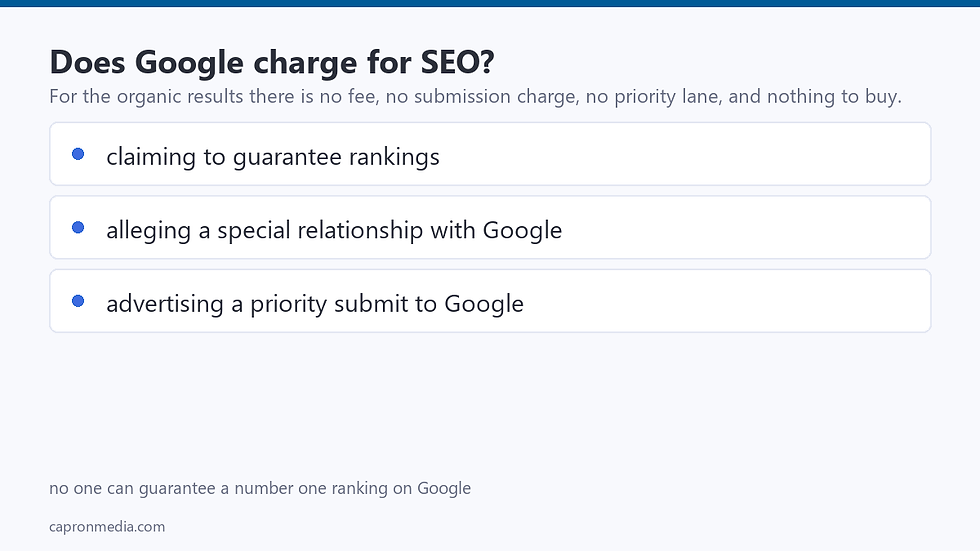
No. Google sells advertising, which is the paid block at the top of a results page and is billed by the click. Google's certification and partner programs are built around that advertising product, not around organic search. For the organic results there is no fee, no submission charge, no priority lane, and nothing to buy. Google's own guidance for people hiring search help says it plainly: no one can guarantee a number one ranking on Google, and you should be wary of anyone claiming to guarantee rankings, alleging a special relationship with Google, or advertising a priority submit to Google. If a quote implies any of those three, the price is the least of the problems with it.
So what are you buying when you buy Google SEO services?
You are buying a person or a company doing work on your website so that Google's software can find it, read it, and judge it worth showing. That work is real and it is ordinary: the words and labels on your pages, the titles and descriptions a searcher sees in the results, whether two of your own pages are competing for the same search, how fast the pages load, whether links inside your own site go anywhere, whether Google can reach every page you want listed. None of that happens at Google. All of it happens on your site, and it is what the monthly figure is paying for.

How much should SEO services cost?
The honest answer is that a monthly figure carries no information on its own, because the same figure can buy wildly different amounts of work. Two quotes at the same number can mean 40 hours of somebody's month or four. What makes a figure readable is the list beside it. Ask for the work to be named: which pages, how many changes, how often, and what arrives at the end of the month so you can see it happened. A number with a list attached can be compared to another number with a list attached. A number on its own can only be compared to your nerve.
The same rule applies in reverse when a quote looks cheap. Cheap is only cheap if the list is the same list. If one proposal names a fixed amount of work each week on a named site and another names a strategy, a partnership, and a commitment to growth, you are not comparing two prices. You are comparing a price to an atmosphere.

Is it worth paying for SEO services?
It is worth paying for if, at the end of a month, you can say what changed. That is a lower bar than it sounds. We have read an owner on a public forum ask whether to fire a new agency that was not delivering what it had said it would, and one of the replies put the real question back: what is the agency actually doing every month, and what results is it getting? A buyer who cannot answer the question of what a month's fee bought has no way to tell a quiet month from a wasted one, and no way to argue the point at renewal. Before you weigh the figure, decide what evidence you will accept each month, and put it in writing with whoever you hire. A provider who is doing the work can produce that easily, and it will tell you more than the figure on the quote.
Can I teach myself SEO instead?
Yes, and for a small site with a handful of pages that can be the right call. The concepts are public, Google documents its own guidance for free, and on a neglected site the first pass of work is often the straightforward part. What you are trading is not difficulty but attention: the work is recurring, it competes with running your business, and the months it gets skipped are the months it quietly stops compounding. The choice is not between a cost and nothing. It is between a monthly fee and a monthly hour of yours that has to come from somewhere.
How to read a quote, line by line
Take the proposal and put every line into one of three piles. One: work on your own website that you could go and look at afterwards, such as page titles, descriptions, speed, or broken links. Two: work somewhere other than your website, such as social posts, advertising, or listings, which may be worth buying and is not the same purchase. Three: lines that describe an attitude rather than an action, such as strategy, partnership, or ongoing optimization with no object attached. Pile three is where the padding lives, and the fix is a question rather than an argument: ask what pile three produces that you could see. Then ask the same of us. We have written the longer version of this exercise in how to choose an SEO agency, and what the recurring work consists of in our guide to ongoing SEO.

The question that separates two quotes at the same figure
Ask what arrives at the end of each month. Not a report of rankings, which moves for reasons neither of you controls, but a record of the changes made: what was altered, on which page, and why. A provider who can hand you that is describing work that exists. A provider who cannot is asking you to price a month you have no way to inspect. That is the real variable behind two identical figures, and it is checkable before you pay rather than four months in.

What a fair figure looks like from your side of the table
A fair figure is one where the work is named, the amount of it is fixed, the record of it arrives without you asking, and leaving is not a negotiation. Whether the number itself is right for you depends on what the work is worth against the other places that money could go, which is your arithmetic rather than anyone else's. What a provider owes you is enough detail to do that arithmetic honestly, and that is what we try to give on our own pricing page.
For what it is worth, we sell the website half of the search work and nothing else: one website, one price, a fixed number of optimizations to your site each week, cancel whenever you like, no contract, and a written record of what changed. New pages, rebuilds, the business profile, link building, ads, social, and email are on the not-included list and are printed there so you can see what you are not buying. Our figure and that list are both on our pricing page, side by side, so you can run the three piles on us before you talk to anyone.
And if you would rather have someone read your own quote with you, book a free SEO consultation. You will speak to the person who does the work.
Written by Spencer Capron at Capron Media, in collaboration with our AI agents. The same way we do the work for clients. Spencer reviews everything published here.


Comments