

White Label SEO: How It Works, What to Ask a Provider, and When to Refer Instead

Updated: 7 days ago
White label SEO is an arrangement in which one company does the SEO work and another company sells it to its own clients under its own name. The client deals with the agency they hired. The supplier makes the changes, writes the reports in the agency's branding, and stays out of sight. It is an ordinary way to sell a service you do not perform in-house.
This page is for agency owners, web designers and advisers whose clients ask about SEO. It covers how white label SEO works, what a provider should do, the risks you take on, the questions to ask, and how it compares with reselling and with referring the client instead. Capron Media does not sell white label SEO; we run a referral program, and we say why below. Whoever does the work, the client should be able to see it and should own it.
What is a white label SEO agency?
A white label SEO agency is a supplier that does SEO for other agencies rather than for businesses directly. The reselling agency sells a monthly SEO package to its client. The work goes to the supplier. The report comes back with the reseller's logo on it. The reseller answers to the client for the result, and the supplier answers to the reseller.

How does white label SEO work?
The reselling agency sells the package and keeps the client relationship. The white label provider does the SEO work and prepares reports under the agency's brand. The agency passes the reports to the client and handles questions. Some providers also join sales calls or speak to clients under the agency's name; others never meet the client at all.
Step | Who does it |
Sells the SEO package and sets the price | The reselling agency |
Gets access to the client's website and accounts | Agreed between the two; ideally the client holds the accounts |
Researches, plans and makes the changes | The white label provider |
Writes the monthly report, in the agency's branding | The white label provider |
Sends the report and answers the client's questions | The reselling agency |
Answers to the client if something goes wrong | The reselling agency |
What does a white label SEO provider do?
Providers offer some mix of the same SEO work an agency would do directly: an audit of the site, keyword research, changes to page titles, headings and copy, technical fixes, content writing, link building and monthly reporting. Some sell the full package; others sell one piece, such as content or links. Ask for the exact list a month includes.
Two items on that list deserve a closer look before you resell them. Content written by someone who has never met the client can read that way, so ask who writes it and who reads it before it goes live. And link building is where the riskiest tactics live. Google's own spam policies list buying links as link spam, and a penalty lands on your client's site, not the supplier's.

From Capron Media: the free Lite subscription

Choosing a provider? Know where you stand first
See where your site shows up in Google search, and which searches moved since the last check. Lite does not include the work on your site. Starter does.
Why do agencies use white label SEO?
Because SEO is a specialist job that some clients ask for and some agencies do not want to staff. A web designer can buy SEO in rather than hire and train a search team for a service a few clients want. The agency keeps the client and the margin; the supplier gets work without having to win clients.
Those benefits are real, and they come with a cost that is easy to miss: you are now answerable for work you did not do and may not see. Everything in the next two sections follows from that.
What are the risks of white label SEO?
The main risk is that you answer for work you cannot see. If the provider uses a tactic Google penalises, writes weak copy, or reports positions without listing changes, your client holds you to account. Google's guidance on hiring an SEO says you are responsible for the actions of any company you hire, and that holds one layer down.
Risk | What it looks like | What to ask for |
Reports with no list of changes | Rankings and a chart, nothing you can check | A dated list of every change, page by page |
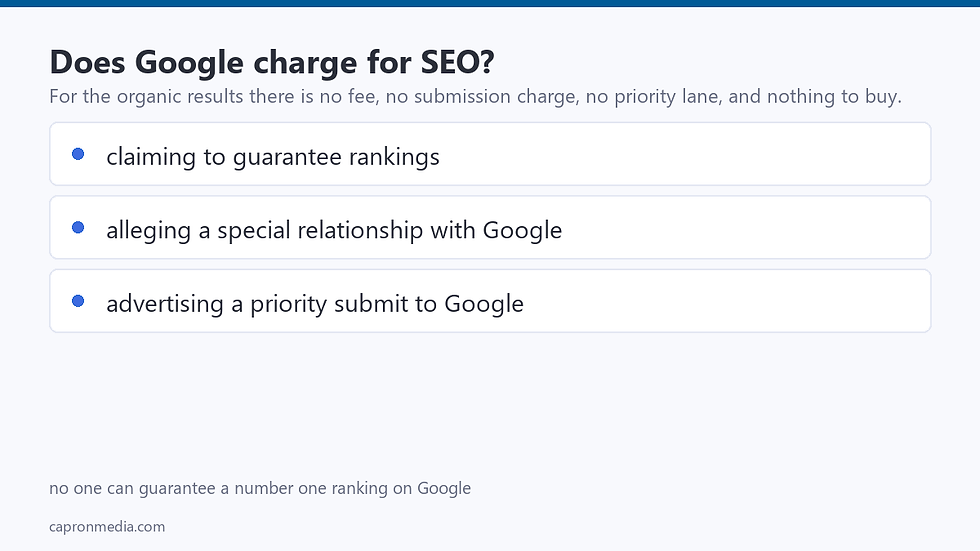
Promised rankings | "Guaranteed page one" in the provider's own sales copy | Walk away. Google says no one can guarantee a number one ranking |
Risky links | Bought links, link networks, paid guest posts | The provider's written list of tactics it will not use |
Copy that does not sound like the client | Generic pages written to a keyword count | Who writes it, and who reads it before it goes live |
Accounts in the wrong name | The supplier owns the analytics or the logins | Accounts in the client's name, providers added as users |
Slow answers | A five-minute question becomes a two-week wait | Direct access to whoever makes the changes, when needed |

What should you ask a white label SEO provider?
Four questions settle most of it. Who does the work. Who holds the logins to the client's site, analytics and Search Console. Can I see last month's list of changes for a client, with dates and the client's details removed. And what stays with the client if either of us leaves. A good provider answers all four in a minute.
What should worry you is a pause on the second question or a change of subject on the third. These are the same questions a business owner should ask any SEO agency, which is why they sit at the centre of our page on how to choose an SEO agency. White label adds a second name to one of the answers, and that is all it adds.

Which white label SEO company is the best?
No list can answer that for you, because the best one is the one whose work you can check and whose tactics you would put your own name to. Shortlist on the four questions above, ask each provider for a sample month with client details removed, and read their own sales copy for promised rankings. Then compare.
How is white label SEO priced?
The supplier charges the agency a wholesale price, and the agency adds its own margin for holding the client relationship and carrying the responsibility. Neither part is wrong. What the client should still be able to see is the list of what was done in the month, because that is what the fee buys.
White label, reseller or referral: which fits your agency?
White label and reselling both put the SEO under your name, so you answer for it. A referral sends the client to the SEO provider directly: the client buys from them, sees the work, and holds them to account, and you stay the adviser who made a good introduction. Which fits depends on whether you want to own the result.
White label | Reseller | Referral | |
Whose name the client sees | Yours | Yours, sometimes with the supplier named | The SEO provider's |
Who the client pays | You | You | The SEO provider |
Who answers for the work | You | You | The SEO provider |
Who sees the list of changes | You, if the supplier sends it | You, if the supplier sends it | The client, directly |
What you earn | Your margin | Your margin | Whatever the referral terms say |
What you have to manage | Delivery questions, reports, renewals | The same | The introduction |
Capron Media (ours) | No white label. | SEO referral program: Referral terms with nothing to sign. No quota. |
Do you need a private label SEO partner?
Only if you want SEO sold under your own name and are ready to answer for it. If clients ask about SEO now and then, referring them to a provider you trust may serve them and you better. If SEO is becoming a real line of your business, a white label partner is a reasonable step.
What should the business owner be able to see?
Whoever does the work, the business paying for it should be able to see a dated list of what changed on its site each month, and should own its content, its tracking and its logins. If you resell SEO, make sure your supplier's reports let you give your client that. If you are the client, ask your agency for it.
A page written for the site belongs on the site after the client stops paying. An analytics account set up for the business should be in the business's name, with the agency added as a user, not the other way round. If the agreement is silent on ownership, that is the easiest thing to fix before money changes hands.

Does Capron Media offer white label SEO?
No. Capron Media does not do white label work. We run a referral program for small agencies, web designers and advisers whose clients ask about SEO: you refer the client, they subscribe with us directly, and they see every change we make on their site. The terms are agreed in a short conversation, with nothing to sign and no quota.
Once terms are agreed, referral partners can run three full audits a month on clients' sites at no charge, carrying the partner's business name beside ours, to share with the client before referring them. If a partnership ever ends, referrals already earning keep paying the partner to the end of their six months while the client stays subscribed. The full terms are on our SEO referral program page.
The part that does not change, whoever does it
Search does not hold still after the first month, so whoever does the work, the question in month four is whether anyone is still doing it. That is true of a white label supplier, a reseller and of us. What that continuing work is, week to week, is set out in our guide to ongoing SEO.
If a client of yours wants the work done for them, Starter is five optimizations a week, made on the site they already own, with every change shown in their portal and no contract. What it costs and what it leaves out is on our pricing page, so you can refer with the numbers in hand.
And if you would rather talk through referring before deciding anything, book a free SEO consultation.
From Capron Media: the free Lite subscription

Check any website, a provider's or your own
Your own site doesn't use up a check. You can check up to three other sites, each once every 30 days. Lite does not include the work on your site. Starter does.
If you would rather have the work done for you, Starter is five optimizations a week, made for you on the site you already own, and each one shown in your portal. See every price.
Written by Spencer Capron, founder of Capron Media, a Middleborough, Massachusetts SEO service for small business owners. Spencer is HubSpot SEO II certified, holds CompTIA Security+, and has run recurring SEO programs for 30+ small-business clients. He wrote this post in collaboration with our AI agents, and he reviews everything published here.


Comments