

SEO Company Rankings: How the Top Agency Lists Are Made, and How to Read One

If you typed this, you wanted a shortcut: somebody else has already sorted the SEO companies, and you would like to start from the top of their list. That is a reasonable thing to want. The trouble is not that the lists are wrong. It is that a ranking of companies is a document somebody made, for a reason, using a method, and the page in front of you may not say which reason or which method. This page is about how to read one, and about the single check that works on any name from any list, including ours.
Who made the list, and why
Here are four ways a ranked list of companies gets made. Somebody reviewed the companies that applied to be on it. Somebody counted reviews left on a site and sorted by the count. Somebody sold the places. Or somebody listed the companies they already work with, which is what a partner directory is. Each of those produces a list that looks the same on the page: a numbered column of names with a logo beside each. The first thing to look for is the sentence that says which method was used. If it is there, the rank has a meaning you can use. If it is not, the rank means whatever the person who made the list wanted it to mean, and they had a reason for making the page that was not your business.

A ranking is marketing for whoever made it
This is worth saying plainly, and without any accusation in it. A list of top SEO companies is published by somebody who had a reason to publish it, and the reason is worth knowing. Sometimes that somebody is a directory that charges the listed companies. Sometimes it is an agency listing its peers, or itself at the top. Sometimes it is a software company that wants you to buy the software. None of those is dishonest. It does mean that a rank reflects whoever made the list, and reading it as an independent measurement of who is good is a mistake the page will not correct for you.
What a rank can tell you, and what it cannot
It can tell you that a company exists, that it is large enough to be noticed by whoever made the list, and that under one method on one day it came out ahead of the names below it. It cannot tell you who will do the work on your account, whether that is the person who sells it to you or somebody hired after you sign. It cannot tell you what a month of the fee buys, as a list of things done to your site. It cannot tell you whether they take a business with one website and a phone number, or whether you would be the smallest account they have. A list was not built to answer those, and they decide whether the money was well spent.

The rank-yourself test, and its limit
One test you can run tonight: search for an SEO company in your own town and see who is at the top. It is a real signal. If a firm is at the top, and not a directory or the map, it is good at ranking for that phrase, which is a thing you want done for you. Its limit is that it shows who is good at ranking their own site for one search. It does not show who works on your pages after you pay, whether there is a term at all, or what happens in month four, and the search result cannot see any of that.
The one check that works on any name
Whichever list the name came from, ask the same two things. First, ask for last month's work on a site they already look after, as a list you can read: which pages, what changed, and what the numbers did. Second, ask for that site's owner as a reference, and call them. If the list exists, it arrives quickly. If a report arrives instead, you have learned something. In one buyer's thread we read, a commenter pointed out that twenty comments in, the room had still not said to ask for case studies, which says something about how far down that room's list the check sat. The other questions worth asking, and the order to ask them in, are on our page about how to choose an SEO agency, and every one of them applies to us.

Is SEO still worth it in 2026?
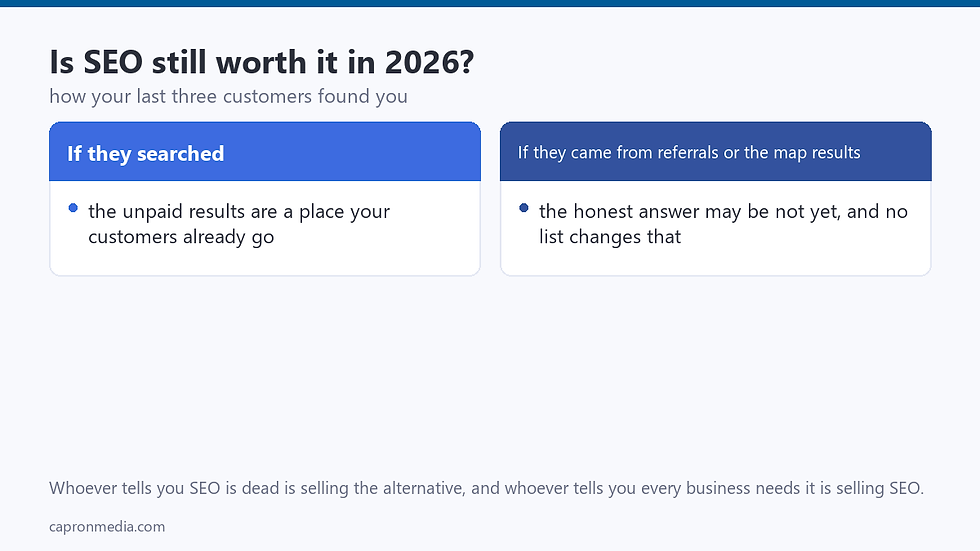
This question sits under the ranking search, and it is the more honest one, because it asks whether to hire anybody at all. The answer depends on one fact about your business that you can check before reading another list: how your last three customers found you. If they searched, then the unpaid results are a place your customers already go, and whether it is worth paying somebody to work on your pages there is a question with a number in it. If they came from referrals or the map results, then the honest answer may be not yet, and no list changes that. Whoever tells you SEO is dead is selling the alternative, and whoever tells you every business needs it is selling SEO.
Will SEO be replaced by AI?
Part of it has already moved. We read the results for ten searches our own site has been shown for; one read failed, and on each of the other nine an AI-written answer sat above the organic results. Most of what it cited was other SEO and agency sites, spread across dozens of them; the single sources it went back to most often were a forum, a video site, and, on the two searches that named a website builder, that builder's own pages. Nobody cited us. That is a measurement about the searches we looked at, not a forecast. What it means for you is that the visible answer at the top of a search is now written by a machine from other people's pages. Google's own guidance says these answers are part of ordinary search, that the same practices apply and that there is nothing extra to do to appear in them; it does not say why one page is chosen over another. What we can say is who is being cited today, and that a page has to be findable before anything can cite it. That part has not changed.
What a list will not show you: the month
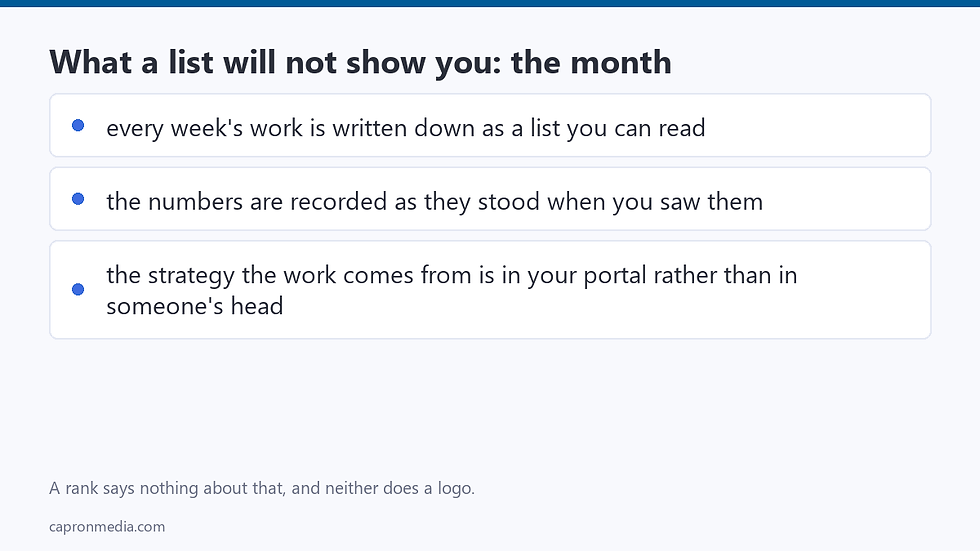
One thing that separates a provider you keep from one you leave is whether you can see what the month bought. A rank says nothing about that, and neither does a logo. Our own answer is that every week's work is written down as a list you can read, the numbers are recorded as they stood when you saw them, and the strategy the work comes from is in your portal rather than in someone's head. What the ongoing part of that involves, and why it does not end when the first results arrive, is in our guide to ongoing SEO. What we charge is one number for one website, with what it includes and what it does not, and you can read it without a call.
Before you call anyone on the list
Read the page for its method, run the two questions on the first name you like, and check how your own customers found you. If after that you would like to talk through what you found with somebody who does the work rather than sells it, a free SEO consultation is a conversation about your site, and one of the answers we give is that you do not need us yet.

We sell a fixed number of things done to your site every week, written down so you can read what the month bought, which is the thing no ranking can show you. What that costs is on our pricing page. It is one number and it does not change with the size of your site.
And if you have a list in front of you and want a second opinion on what the top three actually sell, book a free SEO consultation. You will speak to the person who does the work.
Written by Spencer Capron at Capron Media, in collaboration with our AI agents. The same way we do the work for clients. Spencer reviews everything published here.


Comments