

Organic SEO Agency: What It Does, and How to Tell Earned Traffic From Bought Traffic

Updated: 5 days ago
An organic SEO agency works on your website so that its pages earn places in the unpaid search results, rather than buying places with ads. The work is on the pages themselves: what they say, how they are titled and linked, and whether search engines can reach and read them. Organic is a real distinction, and it is also a word in a pitch.
A word in a pitch is not a number in your analytics. This page covers what organic SEO services include, how they differ from paid search, what agencies charge, and the one report in your own account that settles which kind of traffic you are getting, including from us.
What are organic SEO services?
Organic SEO services are the work done to your own site so its pages earn unpaid positions in search: the words on the pages, the titles and descriptions a searcher sees, how pages link to each other, whether Google can reach and read them, and how fast they load. Some agencies also sell links under the same name.
On the page: titles, headings, descriptions and the words that answer what people search for.
Technical: whether search engines can crawl and index every page you want found, and how fast pages load.
Internal links: pages that point to related pages, so search engines and visitors can follow the topic.
Off the site: links and mentions from other websites. Ask how any links are earned; buying links to raise rankings counts as link spam under Google's rules.
Reporting: what changed, and what happened in search afterwards.
What is the difference between organic and paid search?
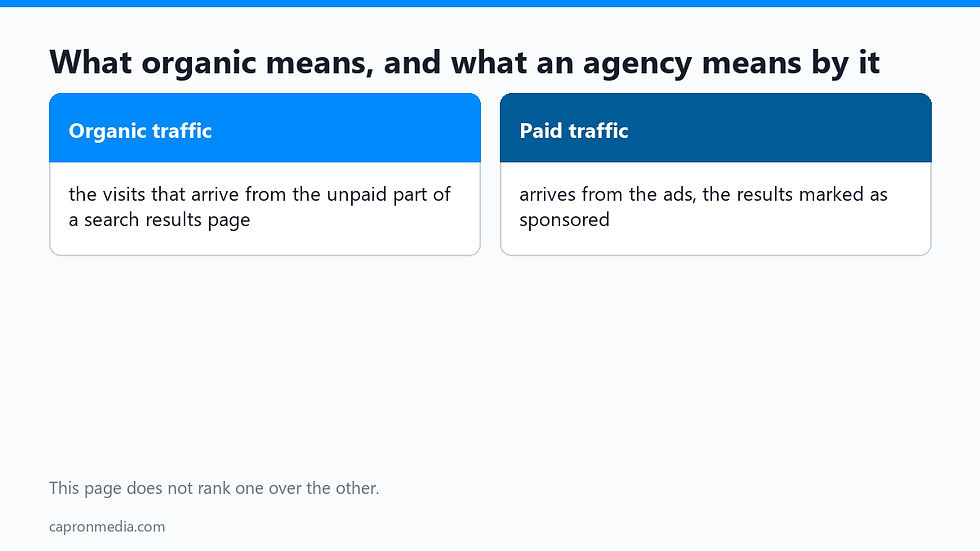
Organic traffic is the visits that arrive from the unpaid results on a search page. Paid traffic arrives from the ads, the results marked as sponsored. Organic positions are earned by the page and last while it stays relevant; paid positions are bought per click and stop with the budget. Both are legitimate, and they are different purchases.
Organic search | Paid search | |
Where it shows | The unpaid results | The results marked as sponsored |
What you pay for | Work on your pages | Each click, through an ad budget |
When it stops | When the page stops being the most relevant answer | When the budget stops |
Where to see it in Google Analytics | The Organic Search row | The Paid Search row |
Capron Media (ours) | Starter: five optimizations a week, made for you on the site you already own, and each one shown in your portal. | Not included: Starter does not include ads. |
How can you tell organic traffic from paid?
Open your own Google Analytics and find the traffic acquisition report. Google sorts every visit into a channel, and Organic Search and Paid Search are separate rows. Google defines Organic Search as visits via non-ad links in organic search results, and Paid Search as visits via ads on search engines. Read both rows for three months.
Search Console reports only the unpaid side, so Search Console numbers are unpaid search traffic; how it got there is a separate question. A total with no channel on it is neither. Do this before the first call, not after the first invoice.

From Capron Media: the free Lite subscription

Choosing a provider? Know where you stand first
See where your site shows up in Google search, and which searches moved since the last check. Lite does not include the work on your site. Starter does.
How much does an SEO agency cost?
SEO agencies charge by the month for ongoing work, by the project for a defined job, or by the hour for advice. Published ranges vary widely. As one example, Percepture's guide to organic SEO services, read on 30 October 2026, puts its basic tier at $2,000 to $5,000 a month and enterprise programs at $25,000 a month and up.
Whatever the figure, ask what the month buys, as a list, before you compare it with anything. Capron Media's own price is one number for one website, and it is on our pricing page with what is included and what is not.
How can a report blur organic and paid?
A report blurs the two most simply with a chart labelled traffic and no channel column. A total that rose during an ad campaign may be the ad budget's work. Impressions count the times a page was shown, not clicked. An average position can move without one visit changing. Ask for the chart with the channel column on it.
None of these are lies. They are numbers that answer a different question from the one you asked.
Can I do SEO on my own?
Yes. An owner can do a good share of organic SEO with free tools: Google Search Console shows which searches your pages appear for and which pages Google has not indexed, and PageSpeed Insights shows how fast a page loads. What takes time is deciding which fixes matter, making them, and checking they went live.
If you have someone with those hours, start there. If nobody does, that is the part an agency is selling.
What should you check before hiring an organic SEO agency?
Before hiring an organic SEO agency, ask what last month's work was, as a list you could read in five minutes. Ask what they will not do, and whether they buy links; bought links are not earned traffic. Ask to see the channel column on a site they work on, and whether that owner would take your call.
A pitch that quotes a share of traffic without saying where the figure came from is telling you about the pitch rather than about search. The rest of the questions worth asking, and the order to ask them in, are in how to choose an SEO agency. Ask every one of them of us too.

Is hiring an SEO company worth it?
It can be, when search is how your customers look for what you sell and nobody in your business has the hours to do the work. It is not worth it when the visits it brings never turn into calls, bookings or sales, or when you cannot see what was done each month. Judge it on enquiries, not on traffic.
Even a clean organic row is a means. Read the key events column beside the channel column, which is what Google Analytics calls the enquiries and calls you told it to count, and ask the provider how they connect an enquiry to the channel it came from. If they cannot, what you are being sold is traffic.

Does organic traffic keep coming after you stop paying?
Not reliably. Earned positions move when others publish, when Google changes how it ranks, and when your own pages go stale. What stays is the work on your pages. A provider who promises earned traffic keeps coming after you stop is making a promise about Google, and nobody controls Google.
That is why the work is ongoing rather than a project with an end date. What the continuing half involves is in our guide to ongoing SEO.

Is SEO dead or evolving in 2026?
Evolving. AI answers in search are built from web pages, and those pages still have to be found, read and trusted. Google's own guidance says that optimizing for generative AI search is optimizing for the search experience, and so is still SEO. What has changed is where the answer is shown.
What Capron Media can show you
We work on one website per subscription, on the part of SEO that is on the site itself. You can see every change: what it was, why it was made, and when. Starter does not include link building or ads, so the visits we can take credit for are the ones in your organic row.

We sell a fixed number of things done to your site every week, and the visits that follow are the ones you can find in your own organic row. What that costs is on our pricing page, with what is included and what is not.
And if you have a report in front of you and cannot tell which row the visits are in, book a free SEO consultation.
From Capron Media: the free Lite subscription

Now add your own visits and clicks
Connect Analytics and Search Console yourself, when ready, and see your own visits and clicks too. Lite does not include the work on your site. Starter does.
If you would rather have the work done for you, Starter is five optimizations a week, made for you on the site you already own, and each one shown in your portal. See every price.
Written by Spencer Capron, founder of Capron Media, a Middleborough, Massachusetts SEO service for small business owners. Spencer is HubSpot SEO II certified, holds CompTIA Security+, and has run recurring SEO programs for 30+ small-business clients. He wrote this post in collaboration with our AI agents, and he reviews everything published here.


Comments