

Google Partner: What the Badge Certifies, and Why It Is Not About SEO

You searched for a Google Partner SEO agency, which means you are doing the sensible thing: looking for a credential before you hand anyone money. The badge is real, Google issues it, and the requirements to hold it are published. The part worth knowing before you shortlist anybody is what those requirements actually measure. They are about Google Ads, the paid results at the top of the page, and none of the three has anything to say about the organic results underneath. The badge still has value. It is a credential for a different job than the one you are probably trying to buy, and we will show you how to tell the two apart.
What the Google Partner badge is issued for
Google publishes the requirements and there are three of them. Performance: the company's registered Google Ads manager account has to hold a minimum optimization score of 70, on a scale that runs to 100. Spend: the company has to maintain a 90-day ad spend of 10,000 USD across the accounts it manages. Certification: at least half of its account strategists have to hold a current Google Ads certification, counted up to a cap of 100 people, with at least one certification in each product area with campaign spend of 500 USD or more in 90 days. Premier Partner is those same three requirements plus a ranking, the top three percent of participating companies in a given country, decided once a year.

Read that list again and notice what is absent from it. There is no requirement about a website's organic rankings, no requirement about content, no requirement about technical health, and no requirement that the company has ever done a day of search work that was not paid for by the click. The badge measures the management of advertising spend. It is an accurate description of a company that runs ads at some scale, checked daily, with a 60-day grace period before a company that slips below the thresholds loses it.

What is the difference between a Google Partner and Google?
A Google Partner is an independent company. Google does not do the work, does not supervise it, and is not a party to your agreement. The badge says the company cleared three published thresholds inside its own Google Ads account. It does not say Google looked at your website, your industry, or the person who would actually be assigned to you. If a company implies the badge gives it a channel into Google, a faster route to being indexed, or influence over where you rank, that is a claim Google itself warns about in writing.

Does Google certify anyone for SEO?
No. Google's own guidance on hiring an SEO is blunt about it: No one can guarantee a #1 ranking on Google. Beware of SEOs that claim to guarantee rankings, allege a special relationship with Google, or advertise a priority submit to Google. There is no Google badge for organic search and no Google register of approved providers. Where a company holds the Ads badge and sells search work, the badge is true and the inference is the thing to watch: it was issued for one and is being shown to you about the other.

How can I find a Google Partner, and what will the directory tell you?
Google runs a public directory of Partner companies, searchable by location and by the product areas each company works in. It will tell you that a company met the three requirements. It will not tell you whether that company does organic search work at all, who at the company would be assigned to your account, or what a month of their work contains. A directory listing is a reasonable way to start a shortlist for advertising. It is not a substitute for asking what you are buying.

How hard is it to become a Google Partner agency?
This question turns up because people want to know how much the badge is worth as a filter. The thresholds are reachable by a company running a working book of ad accounts, and they are re-checked every day, so the badge does tell you something current rather than something historical: this company is actively managing paid campaigns right now, at a scale above the spend floor, with certified people on staff. That is useful information if paid campaigns are what you want. As a filter for organic work it filters almost nothing, because none of the three thresholds is measured on organic work.
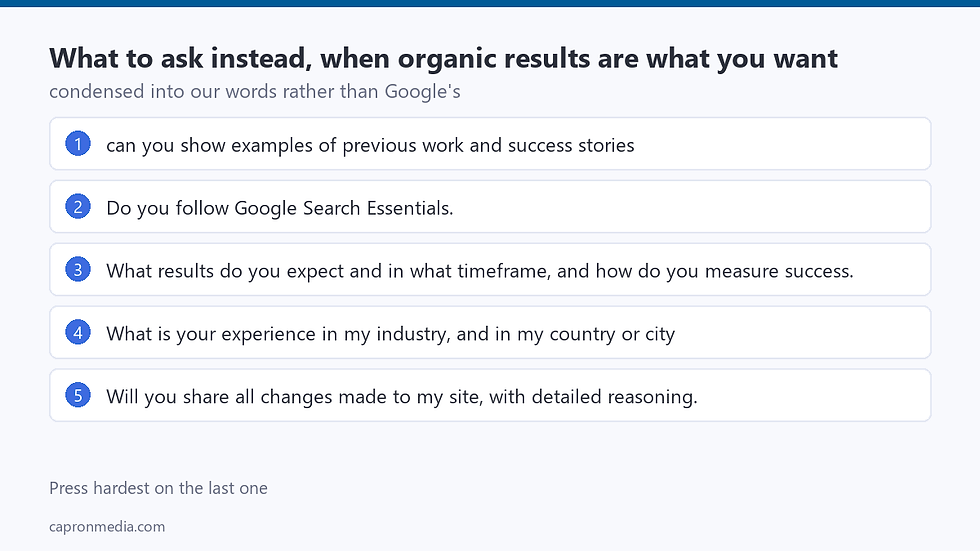
What to ask instead, when organic results are what you want
Google publishes a list of questions to ask before hiring anyone for search work, and they are a better filter than any badge because you can score the answers yourself. The ones worth putting to a shortlist, condensed into our words rather than Google's: can you show examples of previous work and success stories. Do you follow Google Search Essentials. What results do you expect and in what timeframe, and how do you measure success. What is your experience in my industry, and in my country or city, which Google asks as two separate questions. Will you share all changes made to my site, with detailed reasoning. Press hardest on the last one, because it is the only question whose answer keeps arriving after you have paid, rather than once during the pitch. We have written about running those checks on a shortlist in how to choose an SEO agency, and about what the work consists of month to month in our guide to ongoing SEO.
If a badge is what you are shopping for, we will not be in the directory
Google Ads is outside what we do. Paid campaigns, along with social, email, and content marketing, sit on our not-included list, so a credential issued for managing advertising spend is one this business has no reason to hold. If a Partner badge is what you need, the directory is the right place to look. If what you want is the organic side of your website worked on every week with a written record of what changed, that is the part we sell, and we would welcome being checked on those questions rather than on a badge.
What a credential can and cannot stand in for
A shortcut is worth using when it measures the thing you are buying. This one measures ad account performance, ad spend, and ad certifications, which together are a fair description of a company that runs advertising well. Before you let it stand in for a judgment about search work, it helps to know what it was issued for. Google's questions do the rest, because the answers to those are about your site, your industry, and the months after you start, and those are the things you are really buying.
What we sell is the website half of the search work and nothing else: one website, one price, a fixed number of optimizations to your site each week, cancel whenever you like, no contract. Ads, social, email, and content marketing are on the not-included list, and so are new pages, rebuilds, and the business profile. What we charge is on our pricing page, as one number, with the excluded list printed beside it.
And if you would rather put those questions to a person than read another directory entry, book a free SEO consultation. You will speak to the person who does the work.
Written by Spencer Capron at Capron Media, in collaboration with our AI agents. The same way we do the work for clients. Spencer reviews everything published here.


Comments