

After Launch: What to Ask a Web Design and SEO Company About the Months That Follow

Launch day is the end of one job and the start of another, and the second one is the part that tends not to appear on the quote. A new site arrives looking right, loading fast, and with its pages in order, and that state is a snapshot rather than a setting. Your business changes, your competitors publish things, the results page rearranges itself, and the site that was correct in March is merely old by September. The months after launch are the part we work in, so this page is about them: what stops, what has to keep going, and the questions worth asking before you commit, while every option is still open to you.
What is SEO in web design?
During a build it means the decisions that make a site capable of being found: the addresses the pages live at, how the pages link to each other, whether each page has a title and a description you wrote, whether it loads quickly on a phone, and whether a search engine can reach every page you want listed. A good designer handles that as a matter of course, and the result is a site that starts from a sensible position. What it is not is a stock of anything. It is a starting state, and starting states decay at the speed of everything around them.

What stops on launch day
Three things, and they are worth naming because they leave quietly. First, somebody adjusting page titles and descriptions as you learn which searches actually bring people in. Second, somebody noticing when two of your pages start competing for the same phrase, which happens as soon as you add a second service page. Third, somebody watching the technical state: a link that broke when a page was renamed, a page that dropped out of Google's index, a speed score that slipped when a new gallery went in. During the build all three had an owner. On the day after launch, ask who that is.

The questions to ask about the months after the build
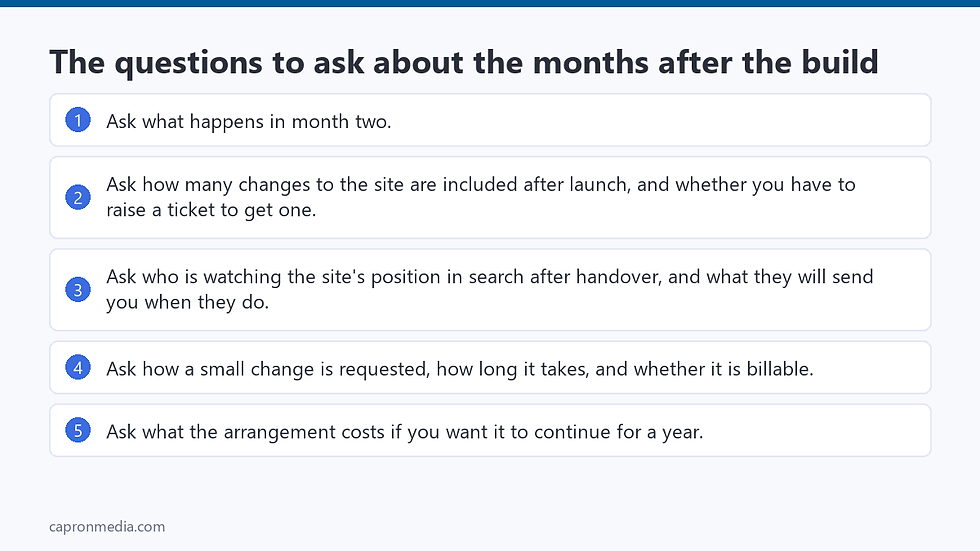
Ask what happens in month two. Ask how many changes to the site are included after launch, and whether you have to raise a ticket to get one. Ask who is watching the site's position in search after handover, and what they will send you when they do. Ask how a small change is requested, how long it takes, and whether it is billable. Ask what the arrangement costs if you want it to continue for a year. None of those questions are hostile and all of them are cheaper to ask now than to discover in February.
How much does it cost to hire someone to do SEO?
The figure varies so widely that a number on its own tells you almost nothing, and the reason is that the same figure can buy a very different quantity of work. What makes a quote readable is the rate beside it: how many changes to your site, how often, and what you receive at the end of a month that shows those changes happened. Ask for the price and the rate together. Two proposals at the same figure, one naming a fixed amount of weekly work on a named site and one naming a strategic partnership, are not two prices to compare. Our own figure, with the list of what it does and does not cover beside it, is on our pricing page, and the reason it is on a page rather than in a call is so it can be compared to somebody else's.
What is an SEO salary, and why that question turns up here
It turns up because an owner staring at a monthly fee is doing an arithmetic in their head: what if I just hired someone. It is a fair comparison and worth doing properly, because the salary is the smaller half of it. An in-house person also needs tools, a manager who knows whether the work is any good, cover for the weeks they are away, and enough work to fill a week once the initial pass is done, which for a site with a dozen pages is the part that rarely holds up. The honest framing is three options rather than two: your own hours, a person on payroll, or a fixed fee for a fixed amount of work. Price each against what it costs you in attention as well as in money.

Is SEO replaced by AI?
Answer engines and search results both work from pages that somebody wrote and that a machine could reach, read, and make sense of. So the underlying work, clear pages, sensible structure, a site that can be crawled, is the same work regardless of what is doing the reading. What is genuinely changing is where the answer appears and what a click is worth, and anyone telling you confidently how that settles is guessing. What has not changed is the part you can control: whether your own pages say what you do, load quickly, and can be found by something that goes looking. Buy work on that, rather than on a prediction.
Who keeps the site after the designer moves on
This is the question the whole page is circling. A build ends, the relationship goes quiet, and 18 months later you cannot remember who has the login and the person who does has moved on. Before that happens, get three things in writing: who owns the site and the domain, who holds the accounts, and what the handover contains if you take the site elsewhere. A company that answers those in a sentence is one you can leave, which is the property that makes staying a choice rather than a default.

The version of this you can do yourself
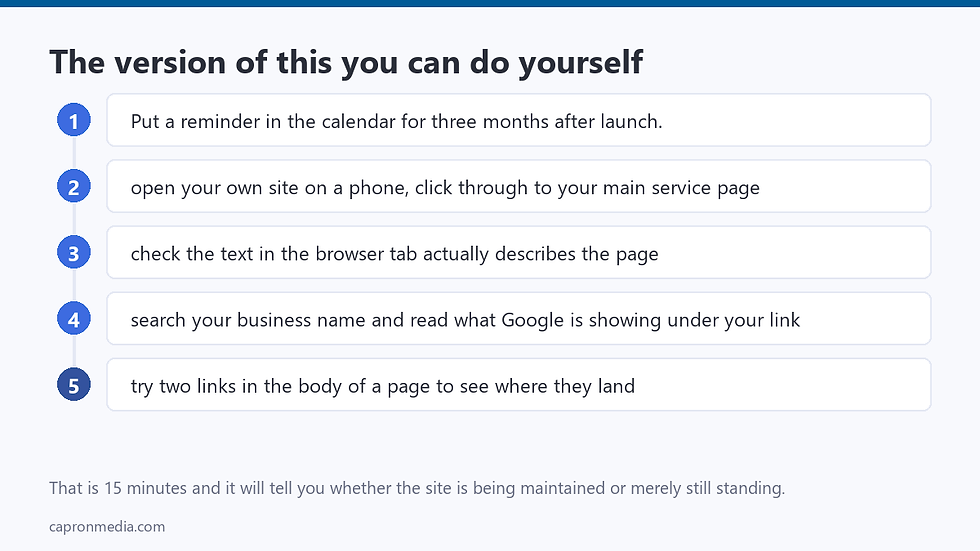
Put a reminder in the calendar for three months after launch. On that day, open your own site on a phone, click through to your main service page, check the text in the browser tab actually describes the page, search your business name and read what Google is showing under your link, and try two links in the body of a page to see where they land. That is 15 minutes and it will tell you whether the site is being maintained or merely still standing. If it is the second, you now know what to buy and why. We have written the longer version of what that maintenance consists of in our guide to ongoing SEO, and how to judge the people who would do it in how to choose an SEO agency.
Where we come into this, and where we do not
Building websites is outside what we do. Redesign and rebuild, new pages and new content, and custom development are on our not-included list, so if you are choosing who builds the site, a combined web design and SEO company may be the right answer for that half, and we would tell you so. What we sell is the half this page is about: the months after launch, on a site somebody else built, at a fixed amount of work a week with a written record of what changed. It is a narrower offer than a combined firm's, and narrow on purpose, so that the months after launch are someone's whole job.
The shape of it, so you can hold it against whatever your designer proposes for month two: one website, one price, a fixed number of optimizations to your site each week, a written record of what changed, cancel whenever you like, no contract. The business profile and local listings, new pages, rebuilds, custom development, link building, social, ads, email, and content marketing are on the not-included list. The figure and that list sit together on our pricing page, which is the comparison this page keeps asking you to be able to make.
And if your site launched a while ago and you would rather have someone look at what has drifted since, book a free SEO consultation. You will speak to the person who does the work.
Written by Spencer Capron at Capron Media, in collaboration with our AI agents. The same way we do the work for clients. Spencer reviews everything published here.


Comments