
SEO and Website Design Together: What the Combined Quote Is Actually Charging For

A company that sells web design and SEO together is selling you two things with very different shapes. One is a project: it has a start, a finish, and a thing you can look at when it is done. The other is a habit: it has no finish, it produces small changes every week, and it stops producing them the moment it is not being done. Putting both on one quote is not a trick. It is convenient, and it is how a large part of this market is organized. The difficulty is that a single number hides which half you are buying, and the two halves fail in opposite ways. We sell only one of the two halves, which is why we care where the line falls.
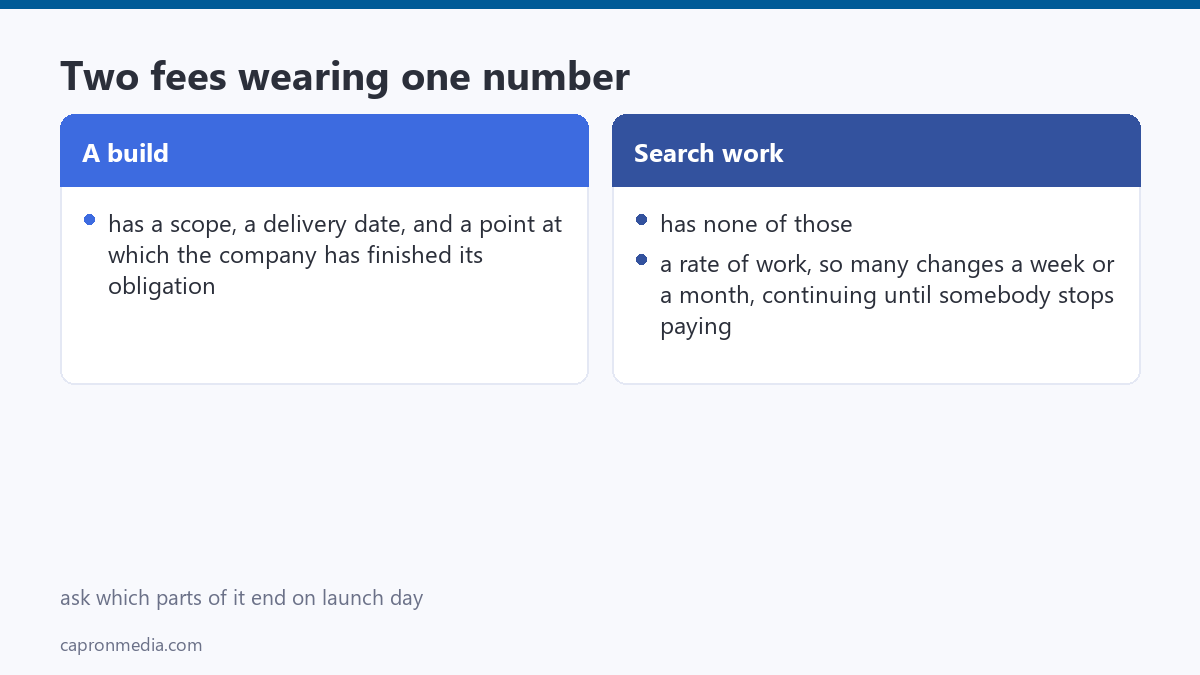
Two fees wearing one number
Read the quote looking for the boundary. A build has a scope, a delivery date, and a point at which the company has finished its obligation. Search work has none of those; what it has instead is a rate of work, so many changes a week or a month, continuing until somebody stops paying. If the quote gives you one figure and one timeline, ask which parts of it end on launch day. That answer tells you more than the rest of the quote put together, because everything after launch depends on it.

What SEO included can mean on a build quote
The phrase covers at least four different purchases and they are not close to equivalent. It can mean a one off pass at launch: titles and descriptions written for each page, the site submitted, the basics in place. It can mean a checklist run once by whoever built the pages, with no plan for the site after that. It can mean genuine recurring work, billed separately or folded into a retainer. Or it can mean the site was built on a platform that does the technical part reasonably, which is true and is not work anyone did for you. Ask which of the four you are being quoted, in those words. A company doing the third will say so immediately, because it is the expensive one.

What does an SEO company do, as distinct from a designer?
A designer decides what a page looks like, how it is laid out, and what a visitor does on it. Search work decides whether anybody arrives at that page from a search box. In practice the two overlap on the same objects: the words in the headings, the structure of the pages, how fast the thing loads, the addresses the pages live at. Where they diverge is time. Design is judged when the site launches. Search work is judged over the months afterwards, by whether the pages are still being adjusted as your business, your competitors, and the results page all change around them.

The three questions that separate the two fees
First: what part of this figure stops when the site goes live. Second: after launch, how many changes to the site are included per month, and who decides which ones. Third: what will I receive at the end of a month that shows the work happened. A build quote can answer the first and be honestly unable to answer the second and third, and that is a fine answer as long as you hear it. What you are guarding against is a quote that implies an answer to all three and commits in writing to only the first.

Is web design still worth it in 2026?
A site is where search work lands, so if the site cannot carry the work then rebuilding it is the first job rather than an optional one. That happens: a site with no way to add pages, no control over titles and descriptions, or a structure that cannot be changed is a genuine blocker. What is worth resisting is the reverse move, where a rebuild is proposed as the answer to a search problem that was not diagnosed. Ask which specific thing about the current site prevents the search work, and ask for it in terms of a page you can open. If the answer is about how the site looks, that may be a good reason to rebuild and it is not a search reason.
Is it worth hiring an SEO agency separately?
Separating the two purchases buys you one thing above all: the ability to stop one without stopping the other. If the same company builds and maintains, ending the search engagement can mean losing the people who know how the site is put together, which makes the decision harder than it should be and is a quiet reason engagements continue past their usefulness. Keeping them separate costs you coordination, and somebody has to own the seam. Neither arrangement is the right one in general. The question is which cost you would rather carry, and you should decide it before you sign rather than in the month you want to leave.

Where a combined company has the real advantage
It is worth being fair about this, because the combined arrangement is not a compromise. A company that built the site can change it without asking anyone, which removes the slowest part of a lot of search work: waiting on somebody else's developer. It can make decisions during the build that the search work would otherwise have to undo later. And there is one bill and one person to call. Where it falls down is the boundary this page is about: when the same invoice covers a project and a habit, the habit is the part that quietly shrinks, because the project has a deadline and the habit does not. The fix is not a different company. It is an itemized quote.
What to do with the quote in front of you
Take a pen to it. Mark every line that is finished on launch day. Mark every line that recurs. If a line could be either, that line is the conversation. Then ask for the recurring half to carry a rate and an output: how much work, how often, and what you receive that shows it happened. A company that sells both halves can answer that in writing without changing a thing about how it works, and a company that cannot is telling you the recurring half was not sized. We have written the version of this for a shortlist of providers in how to choose an SEO agency, and what the recurring half consists of week to week in our guide to ongoing SEO.

Where we sit, which is on one side of the boundary
Building websites is outside what we do. Redesign or rebuild, new pages and new content, and custom development are on our not-included list, and that is a decision rather than a gap: it is what lets the fee be a rate of work on a site that already exists. So if what you need is a site built, a combined firm may be exactly right for the first half of that job, and we will say so. What we sell is the second half, on a site somebody else built, which is the half that keeps going after the launch party. Before we change anything, we ask what you sell and what you want more of, so the work starts from your business.
The shape of our half, for comparison against the recurring lines on your quote: one website, one price, a fixed number of optimizations to your site each week, a written record of what changed, cancel whenever you like, no contract. Rebuilds, new pages, custom development, the business profile, link building, social, ads, email, and content marketing are on the not-included list. The figure and that list are both on our pricing page, which is itself an itemized quote of the kind this page is asking you to request.
And if you would like someone to read the combined quote with you and mark the boundary, book a free SEO consultation. You will speak to the person who does the work.
Written by Spencer Capron at Capron Media, in collaboration with our AI agents. The same way we do the work for clients. Spencer reviews everything published here.


Comments