

The Local SEO Services List: Every Line a Proposal Can Name, and Where to See It

Local SEO is one phrase covering about a dozen separate jobs, which is why two proposals using the same two words can be selling you very different months. This is the list. For each item there is what it is, and then the part that matters more: where you can go and look at it yourself, today, without buying anything. This is worth more than it sounds: of 92 findings we recorded on websites we looked at, 81 were things you would not notice just by reading the page, such as a missing page description or two pages sharing one title, and this list shows you where to check both. An item you cannot check at all can still be real work. It is simply an item you will be taking on trust every month, and it helps to know which ones those are before you agree to anything.
The work that happens off your website
Your business profile on Google
The panel that appears beside the results when somebody searches your business by name: hours, phone number, photos, service area, categories. Work here means keeping those fields accurate and filling the ones left blank. Where to look: search your own business name on Google from a phone. What you see is what a customer sees, and any field that is wrong or empty is visible to you in the same second it is visible to them.
Your name, address, and phone number everywhere else
The same details sit on directories, industry listings, and aggregators, often copied from an old source. Work here means finding the wrong copies and correcting them. Where to look: search your business name together with your town, then open the first two pages of results and read the phone number and address on each. You will know within 10 minutes whether this is a real job on your business or an invented one.

Reviews, and the replies to them
Asking for reviews, and answering the ones that arrive. Where to look: your own profile, the same place a customer reads them. Count how many of the last 10 have a reply. This is one of the few items on the list where the work and the evidence of the work are the same object.
Links from other websites
Sometimes called citations or link building. Someone else's site links to yours. Where to look: this is the hardest item on the list to verify from your side, because you cannot see what has not happened and you cannot easily tell a link that was earned from one that was placed. If a proposal contains this line, ask for the list of links acquired each month, with the dates, and check a sample by opening them.

The work that happens on your own website
The words a searcher sees before they click
The page title and the short description shown under it in the results. These are set per page and they decide whether somebody clicks a result they can already see. Where to look: open one of your pages in a browser and read the text in the tab at the top; that is the title. For the description, search for your page and read the gray text under the link, which is what a searcher sees. That text is not proof of what you have set: Google builds the snippet from the page content first and uses your description when it describes the page better, so it may show words you did not write whether or not your field is filled in. The field itself is in your site editor, under the page's description setting, and that is where to check whether it is set.
The headings on the page
The structural labels running down a page, which tell a reader and a search engine what each part is about. Where to look: on the page, in front of you. If the large text on a page does not say what the section below it is about, that is the improvement to make, and you do not need a tool to see it.

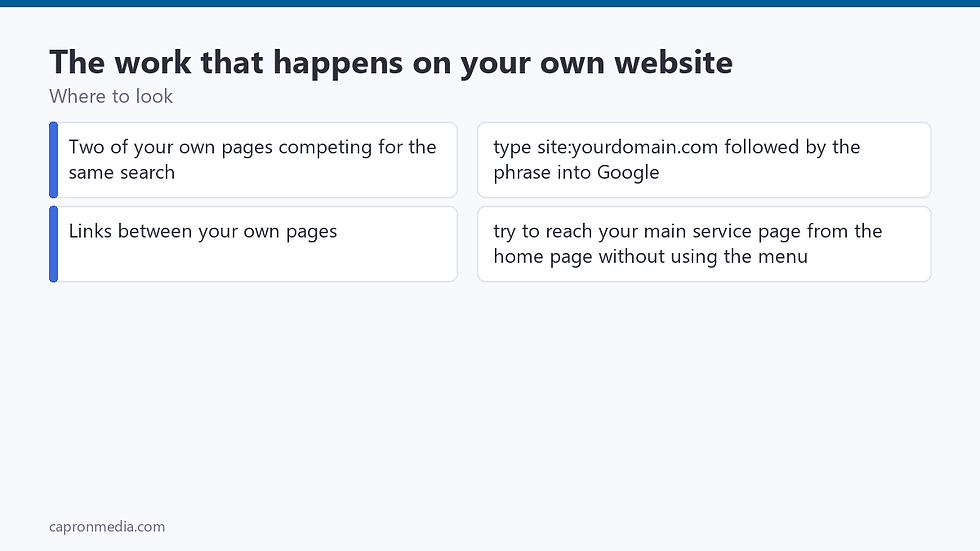
Two of your own pages competing for the same search
Called cannibalization, and it is one of the more expensive quiet problems. Two pages aimed at the same phrase split the signals between them and neither wins. Where to look: type site:yourdomain.com followed by the phrase into Google. If three of your own pages come back and all three are trying to be the answer, you have found it yourself.
Links between your own pages
Whether a visitor, or a search engine, can walk from any page to the pages that matter. Where to look: open your own site on a phone and try to reach your main service page from the home page without using the menu. Then click every link in that page's text and see where they land.
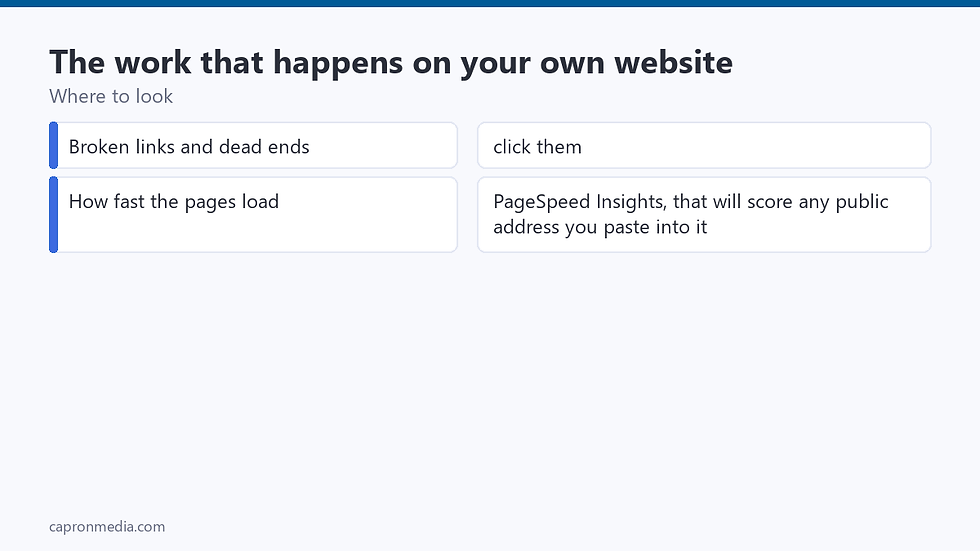
Broken links and dead ends
Links that go nowhere, pages that were deleted, addresses that changed. Where to look: click them. That sounds facetious and it is the actual method for a small site. For a larger one, a free crawler will list them in a few minutes.
How fast the pages load
Measured in the way Google measures it, from a real visit rather than from a stopwatch. Where to look: Google publishes a free tool, PageSpeed Insights, that will score any public address you paste into it. You can run it on your own site and on a competitor's before you talk to a provider, which makes this one of the easiest lines on a proposal to verify.
Whether Google can reach and list your pages
Sometimes called indexing or crawlability. A page a search engine cannot reach is a page it cannot rank. Where to look: Search Console, free, once you have verified you own the site. Until then, search site:yourdomain.com and count what comes back against the number of pages you believe you have.
The structured description search engines read
Machine readable markup describing your business, your hours, or your services. Where to look: this one is genuinely invisible on the page, so the honest answer is a tool. Google publishes a free Rich Results Test that will read any address you give it and show you what it found. Anyone selling you this line should be willing to run it with you before and after.
The text behind your images
Alt text, the description a screen reader speaks and a search engine reads. Where to look: not visible on the page, but visible inside your own website editor, in the field beside each image. Open one page in your editor and check three images.

The work that creates something new
New pages, new articles, a page per town or per service, a rebuild of a site that cannot carry any of the above. These belong on a list of local SEO services and they are a different kind of purchase from everything above, because they are projects with an end rather than work that recurs. Where to look: your own site menu, and the date on your last new page. A proposal mixing recurring work and one off projects into a single monthly figure is not wrong to do so, but you should be able to say which part of the fee stops when the project finishes.
Can I do local SEO myself?
A good deal of the list above is reachable by an owner with an afternoon: the profile fields, the review replies, the directory corrections, the obvious broken links, the headings that do not say what the section is about. What is harder to sustain is not the difficulty but the recurrence. The work is a habit rather than a project, and the months it gets skipped are the months it stops adding up. Do the afternoon first regardless of what you decide about hiring, because it will tell you which lines on somebody's proposal are already done.
Is local SEO free?
Appearing in the results costs nothing, and several of the tools above are published free by Google. What costs money is somebody's time doing the work, every week, on a site that keeps changing. So the choice is not between paying and not paying. It is between paying money and paying attention, and for a business with a few pages and a slow season, paying attention can be the better trade.

Can a chat assistant do an SEO audit?
It can read a page you paste in and tell you sensible things about the words on it. What it cannot do is see your site the way a crawler sees it, measure your load speed from a real visit, read your profile, or know which of your pages are competing with each other. Those need access to your site and to live measurement rather than to the text. Used as a second reader for the words on a page it is useful and cheap. Treated as an audit of the list above, it will return a confident answer about the one part of the list it can see.
How to use this list on a proposal
Print the proposal and put a mark against every line that appears above. Then put a second mark against the ones you have just verified for yourself, because those are the lines where you will be able to tell whether the work happened. Anything left unmarked is either a service this list does not cover, which is worth asking about, or a phrase with no object attached, which is worth asking about harder. The aim is to arrive at an engagement where, at the end of a month, you can point at something and say that changed, which is the standard we set for our own work. We have written the longer version of that conversation in how to choose an SEO agency, and what the recurring half of this list looks like month to month in our guide to ongoing SEO.

We sell one part of the list above and print the rest as excluded, which is worth saying on a page like this one so you can mark our own proposal the same way. We do the work on your own website: the titles and descriptions, the headings, the keyword mapping and cannibalization, the internal links and image text, the speed, the broken links, whether Google can reach every page, and the measurement of all of it, on one website, for one price, a fixed number of changes each week, cancel whenever you like, no contract. The business profile and local listings, new pages and new content, redesign or rebuild, custom development, link building, social, ads, email, and content marketing are all on our not-included list. Both lists sit on our pricing page, next to the figure, so the excluded half is as easy to read as the included half.
And if you would rather walk the list against your own site with somebody, book a free SEO consultation. You will speak to the person who does the work.
Written by Spencer Capron at Capron Media, in collaboration with our AI agents. The same way we do the work for clients. Spencer reviews everything published here.


Comments