

Local SEO Agency Tools: What the Software Finds, and Who Decides What Happens Next

An agency has shown you its software, or you are looking at what one uses before you hire them. The screens look convincing and that is what they are built to do. The question underneath is simpler than which tool is best: a tool produces a list of findings, and a list of findings is not a change to your website. Somebody has to read it, decide which items matter for your business, and then make the change. That gap between the output and the act is where the money goes. We use this kind of software ourselves, so here is how we would read what you are being shown.
The question to ask about any tool you are shown
When a provider shows you a finding on a screen, ask two things. Which tool produced this, and what was done about it. Then, later, ask to see last month's version: the findings that came out of the software, and beside each one what was changed, on which page, on what date. The point is not to audit the software. It is to see whether the tool output is connected to work or whether the tool output is the deliverable. Both arrangements exist, and the fee on its own will not tell you which one you have, so it is worth settling before the first invoice rather than in month four.

What Google publishes about third party SEO tools
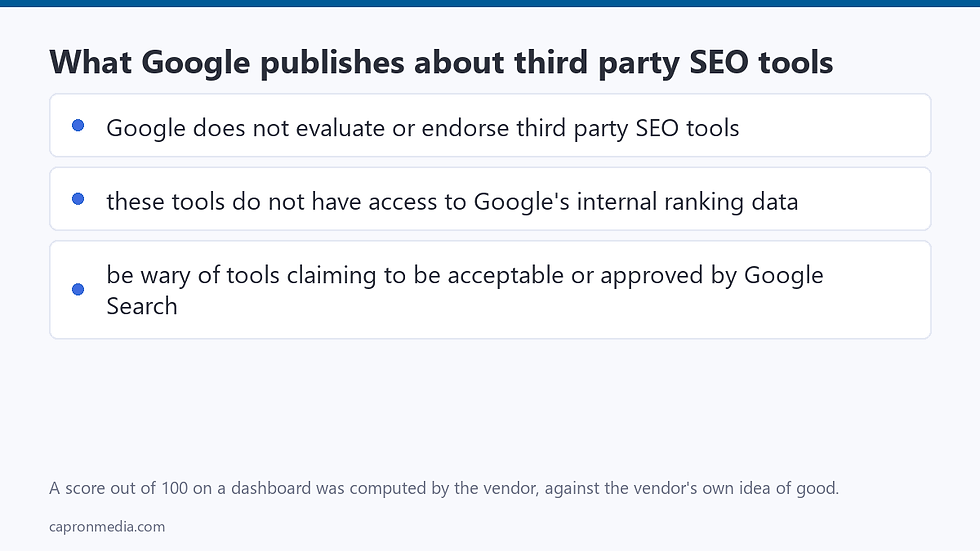
This is worth reading in Google's own words, because it is the one thing on this subject that comes from the company whose results you are trying to appear in. Google's guidance on hiring an SEO says that Google does not evaluate or endorse third party SEO tools, that these tools do not have access to Google's internal ranking data, and that you should be wary of tools claiming to be acceptable or approved by Google Search. It goes further and tells you what to do with a tool's findings: before making significant changes to your site based on a third party tool's audit, check the recommendations against official guidance from Google Search, think critically about the claims, and make your own informed decisions. A score out of 100 on a dashboard was computed by the vendor, against the vendor's own idea of good.
The four kinds of tool, and what each output actually is
A crawler walks your site the way a search engine would and reports what it finds: pages with no title, pages with no description, links that go nowhere, pages that cannot be reached. That output is close to fact and it is the most directly useful of the four. A rank tracker records where a given page appeared for a given search on a given day, from a chosen location, which is a sample rather than a measurement and can differ from what you see on your own screen. A keyword tool estimates how often a phrase is searched, and the estimate comes from the vendor's model, not from Google. A reporting tool assembles all of it into something readable. None of the four decides anything. Each one produces an input.

What is the best SEO tool for agencies, and the best local SEO tools?
We are not going to name products here, and the reason is worth stating rather than hiding: a page that names tools becomes a page about tools, and every name on it would be a factual claim about somebody else's software that we would have to keep current. What we can tell you is the shape of a sensible set. A crawler, so somebody can see the site the way a search engine does. Something that records position over time, so a change can be held against what happened next. Something that estimates demand for phrases, so effort goes to searches people actually make. And the free tooling Google provides for site owners, which reports what Google itself did with your site rather than what a vendor's model thinks. If a provider cannot say what each of their tools is for in one sentence, that is more informative than the names.
The part the software cannot do
A crawler can tell you a page has no description. It cannot tell you what that page is for, which of your services earns the most, where you want to be found, or that the phrase in the estimate is one your customers would not think to type. It cannot tell you that two of your pages are quietly competing and which of them should win. Those are judgments about your business, made by a person who has asked about your business, and they are what the fee is for. The steady version of that judgment, applied week after week rather than once, is the job our guide to ongoing SEO describes.

Can I do local SEO myself, and can I just use the tools?
You can use the tools, and Google says the work is within reach: its guidance states that if you run a small local business you can probably do much of the work yourself, and recommends its own starter guide as the place to start. What you would be taking on is not the software, which is the easy half. It is the reading, the deciding, and the doing, every week, alongside running the business. That is a real trade and it is yours to make. Knowing the trade exists is better than being sold a license and finding out afterwards that the license was the smaller part.
The one report that is not a vendor's opinion
Google publishes a free tool for site owners that reports which of your pages it has indexed, which searches brought people to them, where those pages appeared, and how often somebody clicked. It is the only source in this list that is Google reporting on your site rather than a vendor modeling it. You can connect it yourself, and Google's own guidance suggests giving a provider read access to it at the audit stage rather than write access. Whatever software an agency uses, this is the account you want in your own name, because it is the one that keeps reporting after any provider leaves.

What to ask before you hire the toolset
Take whatever tools you were shown and ask what each one is for, which findings from it were acted on last month, and what changed as a result. If the answers are a screenshot and a score, you are buying a subscription with a person attached. If the answers are a list of changes on named pages with dates, you are buying work with software attached. The wider set of questions, the ones that work on any provider whatever they run, is in how to choose an SEO agency.

Where we sit on this, for the record
We use software, and what we sell is the work it points to. Our own arrangement is deliberately the other way up from a license: the record of what changed on your site each week, with what it was before, what it is now, and why, is what you receive, and the tools are how we get there. The scope of that, and the work on the not included list, is written down for you to read before any call.
One website, one published price, a fixed number of optimizations to your site each week, cancel any time, no contract, and a written record of what changed. What is covered and what is on the not included list, including the business profile, new pages, redesigns, and off page work, is set out on our pricing page.
And if a provider has shown you a dashboard and you want a second read on what it was actually telling you, book a free SEO consultation. You will speak to the person who does the work.
Written by Spencer Capron at Capron Media, in collaboration with our AI agents. The same way we do the work for clients. Spencer reviews everything published here.


Comments