

Good by What Test: Checking an SEO Company Before the First Invoice

Good is a judgment you have to make before you have any evidence, which is the awkward part of hiring anyone for search work. The results arrive months after the money does, and by then you have either chosen well or spent a season finding out you did not. So the useful question is not which company is good. It is which tests you can run today, on a company whose work you have not seen, and whose answers you could score yourself. There are more of those than you might think, and Google publishes a list of them, one we are glad to be judged by too.
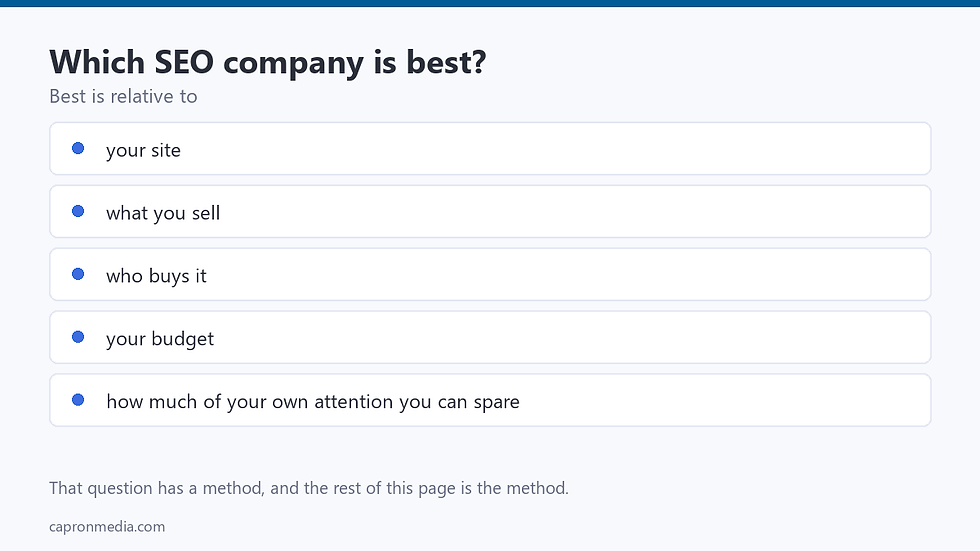
Which SEO company is best?
There is no general answer to this, and a page promising one is a ranked list somebody compiled for a reason. Whether that reason is review volume, an editorial roundup, or the compiler's own place in the ordering is checkable on the page itself, where a disclosure would sit. Best is relative to your site, what you sell, who buys it, your budget, and how much of your own attention you can spare. What does have a general answer is the narrower question underneath it: which company can show you, before you pay, that it knows what it would do on your site and can be checked while it does it. That question has a method, and the rest of this page is the method.
The questions Google publishes
Google's own guidance for anyone hiring search help sets out a list of questions to ask, and what follows is that list in Google's words rather than ours. Can you show me examples of your previous work and share some success stories? Do you follow the Google Search Essentials (previously known as Webmaster Guidelines)? What kind of results do you expect to see, and in what timeframe? How do you measure your success? What's your experience in my industry? What's your experience in my country/city? What's your experience developing international sites? How long have you been in business? How can I expect to communicate with you? Will you share with me all the changes you make to my site, and provide detailed information about your recommendations and the reasoning behind them? Put them to a provider as they stand, because they are the closest thing to a neutral standard in a market that has no licensing body and no required certification.

The same guidance carries a warning that is worth more than the questions: no one can guarantee a number one ranking on Google, and you should be wary of anyone who claims to guarantee rankings, alleges a special relationship with Google, or advertises a priority submit to Google. That single sentence eliminates a category of pitch in one move, and it is Google's own words rather than a competitor's opinion.

The test that costs you nothing
Ask what arrives at the end of a month. Not a ranking report, which moves for reasons neither of you controls and can look impressive in a flat month. A record of changes: what was altered, on which page, and why. A company that can describe that record in a sentence has work that exists in a checkable form. A company that answers with strategy, monitoring, and ongoing optimization has described an attitude, and an attitude produces nothing you can point at in November. You can run this test in a five minute phone call, before any proposal is written.

What a good company will tell you it does not do
An answer worth listening for is the refusal. A company that names what is outside its work, and says so before you ask, has decided what it is rather than trying to be whatever you turn out to want. A provider who will do everything has a scope that expands to fit any question, which sounds accommodating and means the fee covers a month with no definition. Ask directly what is not included; a company that knows its own work will have the answer ready.
What evidence of past work is actually worth
The first of Google's questions asks for examples of previous work, and it is worth being precise about what an example can prove. A screenshot of a rising line proves a line rose. It does not tell you what else was happening, whether the business advertised at the same time, whether a competitor closed, or what the work consisted of. The version of this evidence that carries weight is narrower and less impressive: this was the state of the site, these were the changes, here is the record of them, here is what moved afterwards, and here is what we cannot attribute. A company willing to say the last part is telling you how it will report to you later.

Is SEO still worth it in 2026?
It depends on a thing you can check rather than a thing you have to believe. Look at how people find you now. If customers arrive because somebody recommended you, or because they already know where to find you, and your website is little more than a way to reach you, then search work is a second channel you are choosing to open rather than a leak you are plugging, and it can reasonably wait. If people do search for what you sell, and they are finding somebody else, then the question is not whether the channel works but whether the specific work proposed to you addresses the specific reason you are not there. Ask which reason, and ask on which pages, before you weigh whether it is worth it in general.
Does a good SEO company have to be near you?
The results can be local without the company being local. A search result that shows a map and a set of nearby businesses is responding to where the searcher is, not to where the provider sits, and the work that influences it happens on your website and your profile rather than in a room down the road. What proximity genuinely buys you is a meeting in person and, if your customers are local, somebody who already knows the town names they use. Those are real, and they are preferences rather than requirements. We work with businesses across the United States, and the thing worth insisting on is not a local address but an answer to what Google asks about experience, which it splits into separate questions: what is your experience in my industry, and what is your experience in my country or city.

Search engine optimization agency, SEO company, or SEO provider
These phrases turn up the same kinds of businesses and the label tells you little. A one person operation can call itself an agency. A large firm can call itself a consultancy. What separates them is not the noun but the answers to the questions above: what would be done, on which pages, how often, who would do it, what arrives at the end of a month, and what is excluded. Judge on the answers rather than on the word before the word company.
How to run these tests on us
The tests are only fair if they run in both directions, so here is where our answers sit. What is included and what is excluded is printed on one page rather than described in a call. The record of changes is the thing the service produces every week, which is the answer to the last of Google's questions, and it is the reason the others are answerable at all. There is no contract, so the test of whether the work is worth it is a monthly one rather than an annual one. We have written the longer version of this exercise in how to choose an SEO agency, and what the month to month work consists of in our guide to ongoing SEO. You are welcome to run Google's questions on us first.
The one thing no test can do
None of this predicts a result. It predicts whether you will be able to tell what happened, which is a smaller promise and the only one that can honestly be made before work starts. Choose a company on the checkable things, agree the evidence you will get each month, and keep the ability to stop. Good, in a market where nobody can guarantee a ranking, is a company you can still see into after you have paid it, and that is the kind of company we have tried to build.

For our part: one website, one price, a fixed number of optimizations to your site each week, a written record of what changed, cancel whenever you like, no contract. New pages, rebuilds, the business profile and local listings, link building, social, ads, email, and content marketing are on the not-included list and are printed there rather than discovered later. The figure and the excluded list are both on our pricing page, so the refusal test can be run on us without a phone call.
And if you would rather put those questions to a person and listen to the answers, book a free SEO consultation. You will speak to the person who does the work.
Written by Spencer Capron at Capron Media, in collaboration with our AI agents. The same way we do the work for clients. Spencer reviews everything published here.


Comments